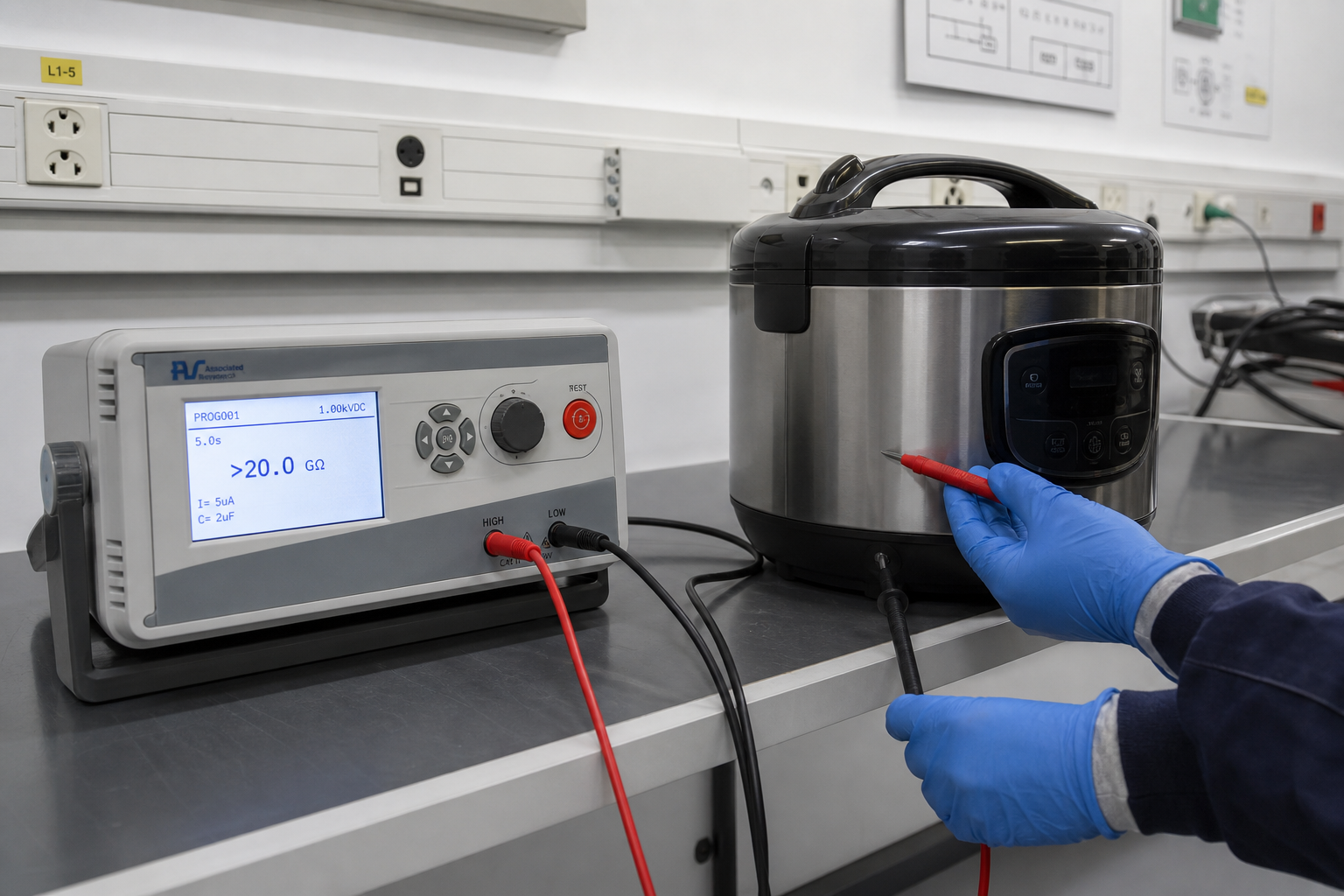
Find the Right Product-Safety Path Before Formal Testing
DESIGN 4 IT reviews product construction, electrical and thermal risks, components, enclosure, documentation and target markets—then manages the applicable testing and corrective workflow.
Construction, spacing, components and documentation before formal evaluation.
Safety evaluationInsulation testing
01Design Review
02Pre-Testing
03Lab Testing
04Remediation
05Certification
PRODUCT-SPECIFIC PREPARATION
Product-Safety Preparation From Design Review Through Evaluation
Product-safety compliance is a construction and risk problem before it is a laboratory event. The applicable standard depends on product function, users, environment, energy sources and market. We review insulation systems, creepage and clearance, accessible energy, temperature, fire risk, protective components, enclosure, wiring and documentation while there is still time to change the design without disrupting production.
01
Select the standard from use, not appearance
Two products with similar enclosures can follow different safety standards because their functions, users, installation environments or energy sources differ. We document intended use and foreseeable conditions, map the likely standard family and identify buyer or market requirements that affect the certification route.
02
Build a defensible critical-component strategy
Fuses, power supplies, relays, transformers, optocouplers, plastics, batteries and protective devices need ratings and evidence appropriate to their use. We connect component documentation to the schematic, BOM and construction so substitutions do not quietly invalidate spacing, temperature or fire assumptions.
03
Prepare construction and documentation together
Spacing, insulation, wiring restraint, enclosure openings and accessible parts are evaluated on the physical sample, while labels and instructions communicate required installation and operation. We review both sides together and organize corrections before samples and production documentation diverge.
COMMON ENGAGEMENT TRIGGERS
Why Teams Start This Path
The team is using “UL certification” as a goal but has not selected the applicable route
Critical components or insulation systems lack suitable ratings or documentation
Creepage, clearance, leakage, temperature or enclosure construction may not meet expectations
A prototype is nearing production without a certification-ready BOM and technical file
Engineering, Testing and Documentation in One Managed Workflow
01
Applicable product-safety standard and NRTL pathway review
02
UL, ETL, CSA, TÜV and CB route coordination as applicable
03
Creepage, clearance, insulation, leakage and dielectric-strength preparation
04
Temperature, abnormal-operation, fire and flame-risk review
05
Critical-component, BOM, wiring and enclosure construction review
06
Label, marking, installation instruction and user-manual checklist
07
Accredited evaluation and laboratory coordination
08
Nonconformity response, engineering corrections and follow-up support
Products this path commonly supports
Information and communications equipmentAudio/video and consumer electronicsLaboratory and measurement equipmentPower supplies and battery-powered productsCommercial appliances and controllersIndustrial and professional equipment
DESIGN 4 IT DIFFERENTIATOR
Engineering Ownership, Not a Test-House Handoff
DESIGN 4 IT prepares construction, components and documentation before an NRTL evaluation, then owns the findings. The goal is a certifiable product architecture—not a last-minute scramble around spacing, plastics or critical-component evidence.
SPECIFIC DELIVERABLES
What This Path Produces
Applicable product-safety standard and NRTL/CB route recommendation
Construction, spacing, insulation, thermal and critical-component review notes
BOM, label and instruction checklist for the evaluation sample
Accredited evaluation coordination and nonconformity response
Corrective engineering for construction or documentation gaps
Send the failed report and available product files. DESIGN 4 IT will organize the failure points, identify likely engineering causes, develop corrective actions and coordinate the next verification or laboratory step.
NDA available before file review. Accepted files: PDF, DOCX, XLSX, ZIP, PNG and JPG. Maximum combined upload size: 25 MB.
TEST DELIVERY
Accredited-Testing Delivery Infrastructure
Formal testing is delivered through ISO/IEC 17025 accredited laboratory infrastructure selected for the applicable scope. DESIGN 4 IT remains the project owner: we prepare samples and requirements, manage the test cycle, interpret results and execute corrective engineering.
RELATED PROGRAMS
Related compliance options
Each service page links back to the master compliance page and to closely related programs.
FAQ
Questions Before You Start?
Is UL always the required certification?
No. The appropriate mark, scheme or declaration depends on product type, market, buyer requirements and the applicable standard. We help organize the practical route.
What is an NRTL?
A Nationally Recognized Testing Laboratory is recognized by OSHA for specific product-safety testing and certification scopes. The selected laboratory and mark depend on the project route.
Can you review the design before the prototype is finished?
Yes. Early schematic, BOM, PCB and mechanical review is often the most efficient time to address spacing, insulation, components, temperature and enclosure risks.
Do you guarantee certification?
No. Formal approval depends on the authorized body’s evaluation and the final product. Our role is to identify risks, prepare the design and documentation, manage the process and resolve findings efficiently.
Can the same work support CE requirements?
Some safety evidence may support multiple routes, but CE, NRTL and CB pathways have different responsibilities and documentation. We organize reuse only where technically and legally appropriate.
START YOUR ASSESSMENT
Ready to organize the next compliance step?
Use the same assessment form below. A DESIGN 4 IT representative will respond within one business day.
COMPLIANCE ASSESSMENT
Request a Compliance Assessment
Share the basics. A DESIGN 4 IT representative will respond within one business day to organize the appropriate next step.
1 business-day response
NDA available
No obligation
Step 1 of 4
Know Your Compliance Path Before You Spend More on Testing
Tell us what the product does, where it will be sold and its current development stage. DESIGN 4 IT will organize the next practical step for compliance preparation, testing or failed-test recovery.
Review the agreement below and complete your digital signature.
MUTUAL NONDISCLOSURE AGREEMENT
This mutual nondisclosure agreement is between [PARTY ONE NAME], a[n] [Business Type] whose principal address is [Full Mailing Address] and DESIGN 4 IT LLC whose principal address is 646 Route 18, East Brunswick, NJ 08816, USA.
Each party has developed certain confidential information that it may disclose to the other party for the purpose of INVENTION DISCLOSURE.
The parties therefore agree as follows:
1. CONFIDENTIAL INFORMATION.
Each party (in such capacity, a "Disclosing Party") may disclose certain of its confidential and proprietary information to the other party (in such capacity, a "Receiving Party"). "Confidential Information" means:
(a) information relating to the Disclosing Party or its current or proposed business, including financial statements, budgets and projections, customer identifying information, potential and intended customers, employers, products, computer programs, specifications, manuals, software, analyses, strategies, marketing plans, business plans, and other confidential information, whether provided orally, in writing, or by any other media, that was or will be:
provided or shown to the Receiving Party by or on behalf of the Disclosing Party; or
obtained by the Receiving Party from review of documents or property of, or communications with, the Disclosing Party; and
(b) all notes, analyses, compilations, studies, summaries, and other material, whether provided orally, in writing, or by any other media, that contain or are based on the information described above (the "Derivative Materials").
The Disclosing Party shall identify Confidential Information disclosed orally within a reasonable time after disclosure, although failure to identify information as Confidential Information is not an acknowledgment or admission that that information is not confidential.
2. OBLIGATION TO MAINTAIN CONFIDENTIALITY.
(a) Confidentiality. The Receiving Party shall keep the Confidential Information confidential. Except as otherwise required by law, the Receiving Party may not:
disclose any Confidential Information to any person or entity other than a representative who needs to know the information, has signed a confidentiality agreement, or has the Disclosing Party's prior written authorization; or
use the Confidential Information for any purposes other than those contemplated by this agreement.
(b) No Reverse Engineering. The Receiving Party may not reverse engineer, disassemble, or decompile any prototypes, software, or other tangible objects that embody the Disclosing Party's Confidential Information and that are provided under this agreement.
(c) Term. The Receiving Party shall maintain the confidentiality and security of the Disclosing Party's Confidential Information until the earlier of: (i) such time as all Confidential Information becomes publicly known through no action or inaction of the Receiving Party or (ii) 2 years from the date of disclosure. Trade secrets remain protected as long as they qualify as trade secrets under law.
3. EXCLUSIONS.
The obligations and restrictions of this agreement do not apply to Confidential Information that the Receiving Party demonstrates:
was or becomes generally publicly available other than as a result of a disclosure in violation of this agreement;
was available to the Receiving Party on a nonconfidential basis before disclosure by the Disclosing Party, provided the source was not restricted and written notice is given where required;
is legally compelled or requested to be disclosed, provided prompt notice and reasonable assistance are given to seek protective relief; or
was developed independently without breach of this agreement.
4. RETURN OF PROPERTY.
All documents and other tangible objects containing or representing Confidential Information disclosed by either party, and all copies in the possession of the other party, remain the property of the Disclosing Party. On request, the Receiving Party shall promptly return or destroy them.
5. OWNERSHIP RIGHTS.
Each party acknowledges that the Confidential Information is and will remain the Disclosing Party's sole property. Neither party obtains any rights, by license or otherwise, in the other party's Confidential Information. Neither party may use the other party's Confidential Information as a basis to develop a competing or similar plan or undertaking.
6. NO OBLIGATION.
Nothing in this agreement obligates either party to proceed with any transaction between them. Any commitment to proceed will be set forth in a separate agreement signed by the parties.
7. NO WARRANTY.
ALL CONFIDENTIAL INFORMATION IS PROVIDED "AS IS." NEITHER PARTY MAKES ANY WARRANTIES, EXPRESS, IMPLIED, OR OTHERWISE, REGARDING THE ACCURACY, COMPLETENESS, OR PERFORMANCE OF ANY SUCH INFORMATION.
8. MISCELLANEOUS.
Choice of Law. The laws of the state of DELAWARE govern this agreement.
Equitable Relief. The parties acknowledge that a breach may cause irreparable harm and equitable relief may be sought.
Amendments. No amendment is effective unless it is in writing and signed by a party or its authorized representative.
No Assignment. Neither party may assign rights or delegate performance without prior written consent of the other party.
Electronic Signatures. Electronic signatures have the same force and effect as original signatures.
Severability. Invalid provisions do not affect the remaining provisions of the agreement.
Waiver. No waiver is effective unless in writing and signed by the waiving party.
Entire Agreement. This agreement is the complete and exclusive expression of the parties' agreement on this subject matter.
Effectiveness. This agreement becomes effective when all parties have signed it.
Digital Signature
Enter your name, title, date, and confirm your consent.
Type your full name exactly as your electronic signature.