Fix EMC Problems Before They Consume Another Test Cycle
DESIGN 4 IT prepares products for conducted and radiated emissions, immunity, ESD, EFT, surge and related EMC testing—then provides corrective engineering when results fall outside the limits.
Design-led remediation when conducted or radiated limits are missed.
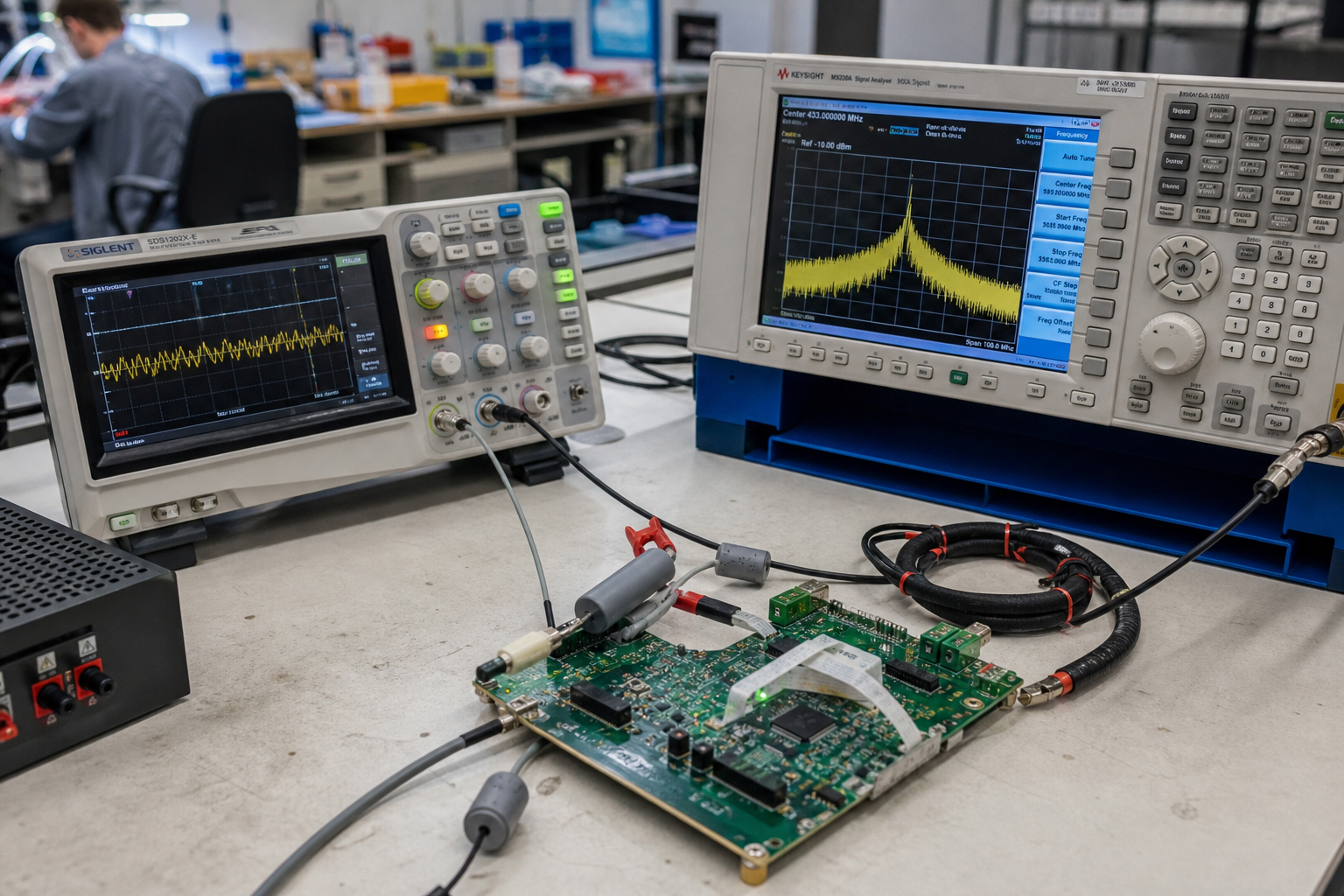
EMC bench debugEmissions monitoring
01Design Review
02Pre-Testing
03Lab Testing
04Remediation
05Certification
PRODUCT-SPECIFIC PREPARATION
EMC Testing, Pre-Compliance Preparation and Failure Remediation
EMC failures are rarely solved by repeating the same test. The useful question is how energy is being generated, coupled and carried through the product. We review switching supplies, clocks, return paths, cable interfaces, grounding, shielding, enclosure seams, filters and operating modes against the applicable emissions and immunity program. The result is a prioritized preparation or corrective plan tied to measurable risks—not a generic list of ferrites.
01
Separate the source, path and antenna
An emissions peak may begin at a clock or switching edge, travel through a return-path discontinuity or common-mode cable current, and radiate from an enclosure seam or attached lead. We use report frequencies, near-field observations, interface behavior and layout review to separate those mechanisms before selecting a corrective action.
02
Define immunity behavior before the chamber
Immunity testing needs meaningful operating modes and pass/fail criteria. A reset, temporary display artifact or communication interruption may have different significance depending on product function and safety. We help define monitoring, exercise vulnerable interfaces and prepare protection at power, signal and enclosure boundaries.
03
Verify corrections before another formal cycle
Corrective components can reduce one symptom while creating thermal, signal-integrity or production issues elsewhere. We organize bench checks or pre-scans around the failed conditions, document the tested configuration and then coordinate a focused laboratory retest using controlled samples.
COMMON ENGAGEMENT TRIGGERS
Why Teams Start This Path
Radiated or conducted emissions exceed a limit at specific frequencies
ESD, EFT, surge or RF immunity causes resets, corrupted data or unsafe behavior
A new power supply, cable, enclosure or PCB revision changed previous EMC performance
The team has a failed report but no clear engineering path to a retest
Engineering, Testing and Documentation in One Managed Workflow
01
Conducted and radiated emissions planning and troubleshooting
02
Radiated and conducted immunity preparation
03
ESD, EFT/burst, surge and voltage-dip support
04
Harmonics, flicker and power-interface review where applicable
05
Grounding, shielding, filtering, cable and interface review
06
PCB stack-up, return-path and high-frequency layout corrections
07
Pre-scan planning, debug-session support and design verification
08
Accredited laboratory scheduling, test management and retest coordination
Products this path commonly supports
Embedded systems and controllersIndustrial electronics and motor controlsDisplays and computing equipmentPower converters, chargers and suppliesConnected products with external cablesCommercial and professional equipment
DESIGN 4 IT DIFFERENTIATOR
Engineering Ownership, Not a Test-House Handoff
DESIGN 4 IT treats EMC as a design problem. We connect emissions and immunity results to sources, coupling paths and product geometry, then implement schematic, PCB, filter, shielding and enclosure corrections in the same engagement.
SPECIFIC DELIVERABLES
What This Path Produces
Emissions/immunity risk assessment tied to the product architecture and interfaces
Prioritized corrective actions for grounding, filtering, shielding, cables and PCB return paths
Pre-scan or debug plan around the failed or high-risk conditions
Accredited laboratory coordination and controlled retest support
Configuration notes so the next test represents the product that will ship
Send the failed report and available product files. DESIGN 4 IT will organize the failure points, identify likely engineering causes, develop corrective actions and coordinate the next verification or laboratory step.
NDA available before file review. Accepted files: PDF, DOCX, XLSX, ZIP, PNG and JPG. Maximum combined upload size: 25 MB.
TEST DELIVERY
Accredited-Testing Delivery Infrastructure
Formal testing is delivered through ISO/IEC 17025 accredited laboratory infrastructure selected for the applicable scope. DESIGN 4 IT remains the project owner: we prepare samples and requirements, manage the test cycle, interpret results and execute corrective engineering.
RELATED PROGRAMS
Related compliance options
Each service page links back to the master compliance page and to closely related programs.
FAQ
Questions Before You Start?
What files should I send after an EMC failure?
Send the complete report, product photos, test configuration, cables and peripherals used, schematics, PCB files, BOM, enclosure details and notes about product behavior during the failure. Partial information is still enough to begin triage.
Can you modify the PCB or enclosure?
Yes. Corrective work can include schematic, PCB layout, grounding, filtering, shielding, cable-interface and enclosure changes when those changes are included in the agreed scope.
Do I need pre-compliance testing?
It is not mandatory for every project, but targeted pre-compliance work can reveal avoidable problems before formal testing and is especially useful after major architecture or enclosure changes.
What is the difference between EMI and EMC?
EMI commonly refers to unwanted electromagnetic interference or emissions. EMC is the broader ability of equipment to operate acceptably in its electromagnetic environment while controlling emissions and tolerating applicable disturbances.
Can you coordinate the retest?
Yes. We can organize corrective actions, verification, updated samples and communication with the accredited laboratory for the next test cycle.
START YOUR ASSESSMENT
Ready to organize the next compliance step?
Use the same assessment form below. A DESIGN 4 IT representative will respond within one business day.
COMPLIANCE ASSESSMENT
Request a Compliance Assessment
Share the basics. A DESIGN 4 IT representative will respond within one business day to organize the appropriate next step.
1 business-day response
NDA available
No obligation
Step 1 of 4
Know Your Compliance Path Before You Spend More on Testing
Tell us what the product does, where it will be sold and its current development stage. DESIGN 4 IT will organize the next practical step for compliance preparation, testing or failed-test recovery.
Review the agreement below and complete your digital signature.
MUTUAL NONDISCLOSURE AGREEMENT
This mutual nondisclosure agreement is between [PARTY ONE NAME], a[n] [Business Type] whose principal address is [Full Mailing Address] and DESIGN 4 IT LLC whose principal address is 646 Route 18, East Brunswick, NJ 08816, USA.
Each party has developed certain confidential information that it may disclose to the other party for the purpose of INVENTION DISCLOSURE.
The parties therefore agree as follows:
1. CONFIDENTIAL INFORMATION.
Each party (in such capacity, a "Disclosing Party") may disclose certain of its confidential and proprietary information to the other party (in such capacity, a "Receiving Party"). "Confidential Information" means:
(a) information relating to the Disclosing Party or its current or proposed business, including financial statements, budgets and projections, customer identifying information, potential and intended customers, employers, products, computer programs, specifications, manuals, software, analyses, strategies, marketing plans, business plans, and other confidential information, whether provided orally, in writing, or by any other media, that was or will be:
provided or shown to the Receiving Party by or on behalf of the Disclosing Party; or
obtained by the Receiving Party from review of documents or property of, or communications with, the Disclosing Party; and
(b) all notes, analyses, compilations, studies, summaries, and other material, whether provided orally, in writing, or by any other media, that contain or are based on the information described above (the "Derivative Materials").
The Disclosing Party shall identify Confidential Information disclosed orally within a reasonable time after disclosure, although failure to identify information as Confidential Information is not an acknowledgment or admission that that information is not confidential.
2. OBLIGATION TO MAINTAIN CONFIDENTIALITY.
(a) Confidentiality. The Receiving Party shall keep the Confidential Information confidential. Except as otherwise required by law, the Receiving Party may not:
disclose any Confidential Information to any person or entity other than a representative who needs to know the information, has signed a confidentiality agreement, or has the Disclosing Party's prior written authorization; or
use the Confidential Information for any purposes other than those contemplated by this agreement.
(b) No Reverse Engineering. The Receiving Party may not reverse engineer, disassemble, or decompile any prototypes, software, or other tangible objects that embody the Disclosing Party's Confidential Information and that are provided under this agreement.
(c) Term. The Receiving Party shall maintain the confidentiality and security of the Disclosing Party's Confidential Information until the earlier of: (i) such time as all Confidential Information becomes publicly known through no action or inaction of the Receiving Party or (ii) 2 years from the date of disclosure. Trade secrets remain protected as long as they qualify as trade secrets under law.
3. EXCLUSIONS.
The obligations and restrictions of this agreement do not apply to Confidential Information that the Receiving Party demonstrates:
was or becomes generally publicly available other than as a result of a disclosure in violation of this agreement;
was available to the Receiving Party on a nonconfidential basis before disclosure by the Disclosing Party, provided the source was not restricted and written notice is given where required;
is legally compelled or requested to be disclosed, provided prompt notice and reasonable assistance are given to seek protective relief; or
was developed independently without breach of this agreement.
4. RETURN OF PROPERTY.
All documents and other tangible objects containing or representing Confidential Information disclosed by either party, and all copies in the possession of the other party, remain the property of the Disclosing Party. On request, the Receiving Party shall promptly return or destroy them.
5. OWNERSHIP RIGHTS.
Each party acknowledges that the Confidential Information is and will remain the Disclosing Party's sole property. Neither party obtains any rights, by license or otherwise, in the other party's Confidential Information. Neither party may use the other party's Confidential Information as a basis to develop a competing or similar plan or undertaking.
6. NO OBLIGATION.
Nothing in this agreement obligates either party to proceed with any transaction between them. Any commitment to proceed will be set forth in a separate agreement signed by the parties.
7. NO WARRANTY.
ALL CONFIDENTIAL INFORMATION IS PROVIDED "AS IS." NEITHER PARTY MAKES ANY WARRANTIES, EXPRESS, IMPLIED, OR OTHERWISE, REGARDING THE ACCURACY, COMPLETENESS, OR PERFORMANCE OF ANY SUCH INFORMATION.
8. MISCELLANEOUS.
Choice of Law. The laws of the state of DELAWARE govern this agreement.
Equitable Relief. The parties acknowledge that a breach may cause irreparable harm and equitable relief may be sought.
Amendments. No amendment is effective unless it is in writing and signed by a party or its authorized representative.
No Assignment. Neither party may assign rights or delegate performance without prior written consent of the other party.
Electronic Signatures. Electronic signatures have the same force and effect as original signatures.
Severability. Invalid provisions do not affect the remaining provisions of the agreement.
Waiver. No waiver is effective unless in writing and signed by the waiving party.
Entire Agreement. This agreement is the complete and exclusive expression of the parties' agreement on this subject matter.
Effectiveness. This agreement becomes effective when all parties have signed it.
Digital Signature
Enter your name, title, date, and confirm your consent.
Type your full name exactly as your electronic signature.