
Case Study
Consumer self-defense conceptStun Gun: A Girly Innovation
A bold student-led idea reframed self-defense as something empowering, discreet, and intentional.
We partnered with Sydney, a young entrepreneur determined to challenge the visual language of self-defense products. Instead of building another intimidating gadget, the project aimed to make personal protection feel more approachable, more elegant, and more trustworthy.
Core Opportunity
Design a safety product women would actually want to carry
Product Stack
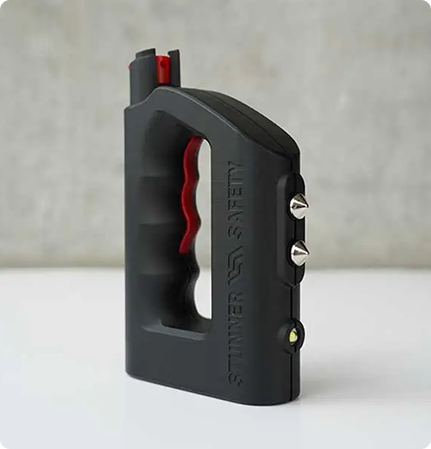
LED visibility, pepper spray, and a rechargeable stun system in one device
“Can protection feel empowering, not intimidating?”
Where It Began
A student idea with real emotional clarity
The concept was not just functional. It was cultural.
Sydney entered the room with a product idea and a point of view: the self-defense category felt visually hostile, performatively tactical, and disconnected from the people most likely to buy it.
Her concept fused three functions into a single compact object: a high-intensity LED for visibility, a pepper-spray capsule, and a rechargeable stun system built for reliability.
We began exactly where many real hardware stories begin — on a bench, wiring prototypes by hand. When the first high-voltage arc cracked across the test leads, it confirmed both the opportunity and the responsibility of the project.
Early Design Constraints
Make it feel safe to hold before it ever needs to be used.
- Avoid the aggressive visual language common in the category
- Balance compact carry with real electrical performance
- Translate a founder’s vision into a product architecture that could scale
Product Vision
The goal was never to make it look softer. The goal was to make it feel more intentional.

Engineering the Impossible
Miniaturization became the real fight
Power density, safety, and grip quality had to coexist in the same enclosure.

The hardest problem was not making the device work once. It was making it work reliably inside a form factor that still felt good in the hand.
The package had to contain a lithium-ion battery, high-voltage components, bright LED hardware, and a defensive payload without turning the device into something clumsy or intimidating.
- Dozens of board and enclosure iterations to control heat, routing, and power density
- Grip-focused ergonomic studies so the object felt secure rather than bulky
- Electrical safety decisions that respected real-world handling, charging, and carry conditions
Rough on the bench, refined in the hand. That became the standard for every iteration.
Design Evolution
Trust had to be designed as carefully as the circuitry
The product needed to look credible, feel empowering, and avoid becoming either toy-like or unnecessarily aggressive.
Design priorities
- Create a silhouette that felt modern and confident, not tactical for the sake of drama
- Use proportion, finish, and grip details to communicate quality and control
- Preserve emotional clarity while preparing the product for launch and manufacturing conversations
Protection can feel personal without feeling fragile.

Testing
Bench validation, fit checks, and iteration cycles


Outcome
From founder vision to a product story ready for market
The work was not just about hardware. It was about giving the concept enough clarity to travel.
The project matured from a bold concept into a more credible consumer product narrative: one with a clearer visual identity, a stronger technical backbone, and a story people could immediately understand.
That shift mattered. Products like this do not succeed on specification sheets alone. They succeed when design, trust, and manufacturability start pointing in the same direction.
The founder took the idea forward despite real hurdles, and the final result proved that a more emotionally intelligent approach to protection can still be technically serious.
What changed
- A clearer product position in a crowded category
- A more premium, confidence-first design language
- A launch story that connected engineering with user trust
Gallery
Product moments, details, and visual direction


Reflection
What this project proved
Consumer safety products do not have to borrow their confidence from fear.
Good self-defense design is not about making something look more threatening. It is about making the user feel more prepared, more in control, and more likely to keep the product close at hand.
This project showed how industrial design, storytelling, and electronics can work together to create a product identity that is both credible and emotionally legible.
That is the kind of product work DESIGN 4 IT does best: turning a sharp insight into something ready to be believed.
Empowerment is not a styling pass. It is a product strategy.
Have a product idea that needs stronger UX, better hardware thinking, or a launch-ready visual system? Let’s talk.