
Case Study
AUDITUS — THE SOUND YOU FORGOT YOU COULD FEEL
A discreet bone-conduction wearable designed to feel personal, effortless, and invisible in everyday life.
Auditus started with an unusual challenge: design an assistive listening device for people with mild hearing loss that did not feel like medical equipment.
The product needed to blend into daily life — subtle, wearable, functional, and intimate enough to never feel like a “device.”
Where it started
The founder of Auditus came to us frustrated by a market full of products that either looked unmistakably medical or overcompensated by mimicking generic consumer electronics.
Neither path answered the real design question: what if sound did not come from your ears?
Design direction
- Make the product visually discreet
- Preserve comfort through long wear sessions
- Keep the experience intuitive and non-clinical
- Balance technical performance with emotional fit
02
The Spark
Bone conduction is not new. It has existed in military headsets, swim gear, and niche cycling products for years. But most of those designs treated it as a technical feature, not an everyday experience.
We asked a better question: what if a wearable transferred sound through the skull not as a workaround, but as a design choice? What if we could build something you would forget you were wearing — until you needed it?
That question shaped every design decision that followed.
Visual process
From concept to refinement
A more editorial presentation makes the product story easier to absorb.
03
Engineering
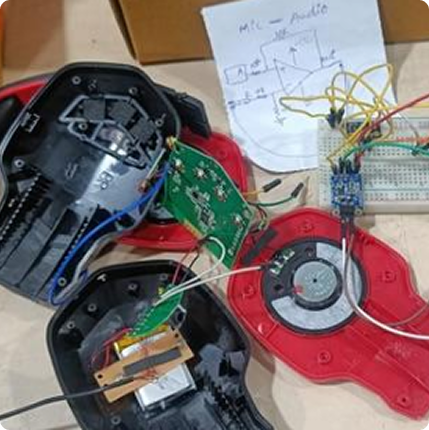
We built around a miniaturized transducer stack capable of delivering clear, distortion-free vibration across a wide frequency range — without overheating or draining the battery in under 90 minutes.
That required tight tradeoffs across every layer of the device:
- Custom piezo actuators tuned for speech and mid-range audio
- Low-power DSP to boost clarity without noticeable latency
- Flexible PCB architecture that wraps around the ear without bulk
If a component did not improve sound, comfort, or battery life, it was removed.
04
Design Evolution
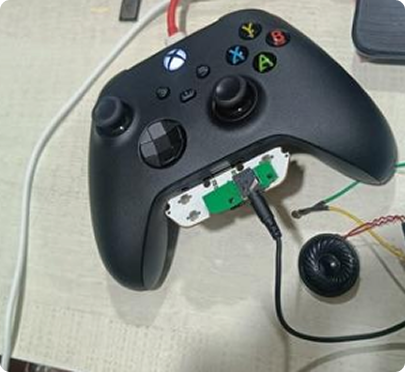
We moved through multiple iterations — from bulky proof-of-concept prototypes to a refined, minimal final form. Early versions focused purely on function. Later versions tightened the silhouette and improved wearability without sacrificing acoustic performance.
The goal was not just to make it smaller or cleaner. It was to make it disappear into daily life.
05
The oTo
We called the first working prototype “oTo” — a nod to the Latin root for ear. The name stayed.
The oTo wraps around the back of the ear with a spring-loaded titanium frame covered in medical-grade silicone. The bone-contact point was carefully contoured to distribute pressure evenly. Too much force, and it becomes uncomfortable. Too little, and the audio loses strength.
Balancing that threshold took 14 frame revisions.
06
Outcome & Reflection
The oTo launched quietly — fitting, given what it does.
Early adopters included people with conductive hearing loss, audiophiles who wanted open-ear listening, and professionals who needed hands-free communication without blocking ambient sound.
It did not try to be everything. It tried to be forgotten. That is what made it work.
What users remembered
“I forgot I was wearing it.”
“It felt like part of me.”
Auditus taught us that the best assistive tech does not feel assistive.
It feels personal.
When you design for intimacy — the small moments where a device becomes part of someone’s routine — you stop designing products and start designing experiences.
The best technology is invisible. It serves without announcing itself.
Have a product idea?